
Friday, 23 January 2026
Orpheus and Eurydice, poetical spectacle
Running time: The performance lasts approximately 105 minutes. YT trailer
One of the most striking myths about love beyond death, dating back to ancient Greece, is the story of Orpheus and Eurydice. In an attempt to bring Eurydice back to life, Orpheus decided to go to the land of the dead. He gained passage by charming with music both the three-headed Cerberus, the monstrous watchdog of the world of the dead, and the elderly ferryman Charon, who took him deeper underground on the River Styx. Orpheus’ song was so heartbreaking that even the ruler of the
underworld, Hades, and his wife Persephone, were moved to compassion. He was allowed to take Eurydice back with him, but on one condition – he was forbidden to look back while still in the land of the dead. The couple climbed up toward the opening into the world of the living. Unable to hear Eurydice’s footsteps, Orpheus broke his promise. The last thing he saw was Eurydice’s vanishing pale face.
The tale of undying love, a source of inspiration to numerous artists since ancient times, also has a dark side. The vast majority of its representations features Orpheus as the central figure, and Eurydice merely as his silent and passive companion. Poet and playwright Urša Majcen’s adaptation turns the myth upside down and casts Eurydice as the main protagonist. Is returning to the world of the living really a salvation for Eurydice? Did anyone ask her if that was what she wanted?
Urša Majcen’s Eurydice sends a clear message: she no longer wants to participate in the game controlled by Orpheus, she will discard the role that calls for passivity and silence, she will end the story of sacrifice for the myth of the suffering and omnipotent artist. In other words: she will remain dead. In making her decision, she speaks for all the women who have lost their voice or their lives in the name of love or art. In the Underworld, Orpheus encounters both mythological and
historical figures. For the writer Virginia Woolf, the poet Sylvia Plath, and the playwright Sarah Kane – as for Eurydice – the world of the dead is a place to search for a room of one’s own and liberation from social roles. Roles that suffocated and restricted them during their lives, prompting them to make a renunciation similar to the one voiced and substantiated by Urša Majcen’s Eurydice.
Rather than destructive, Eurydice’s rejection of the myth is reflective and emancipatory. In discussion with Persephone, Orpheus finally recognises this too, and sees the myth from a new perspective. He realises that he never truly knew his one love, the woman he descended to the land of the dead for, because he failed to really see or hear her. Above all, he failed to understand that she wanted to have a voice of her own and not just be an inspiration for his. Eurydice now makes him realise
his mistake and stop repeating the old and long-outdated patterns of social relations.
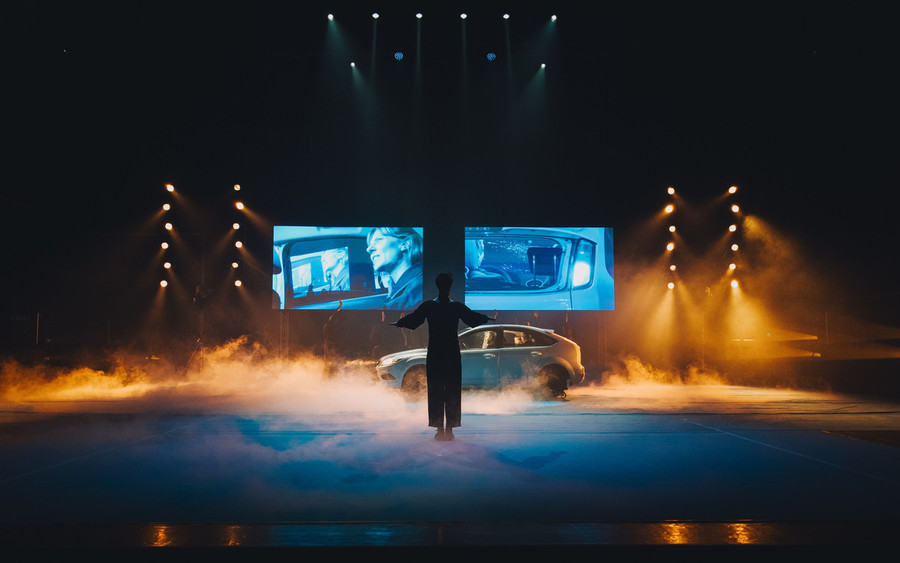
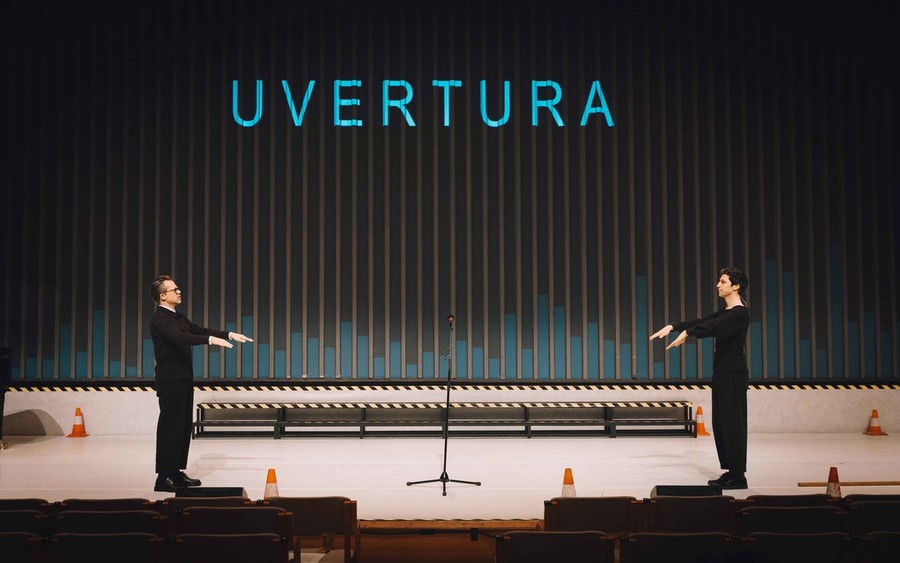
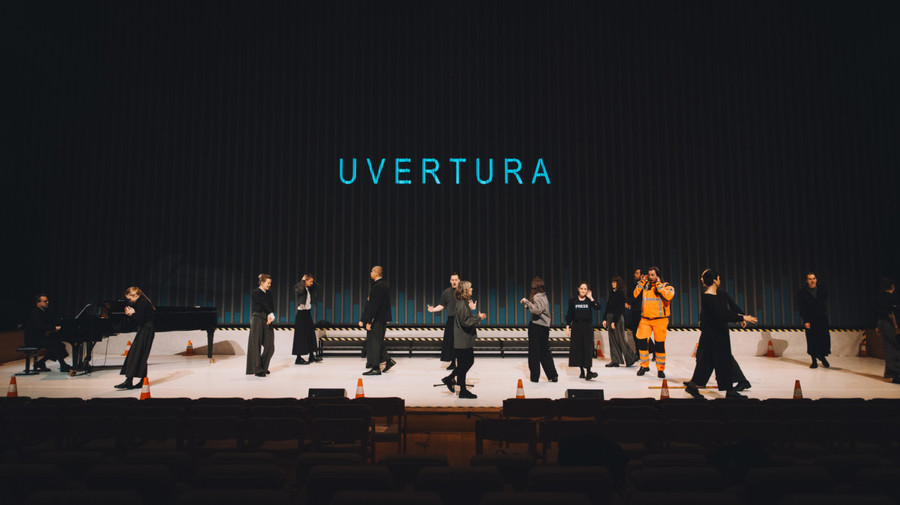
Based on a stage adaptation by Urša Majcen and a musical score by composer Sašo Vollmaier, the myth of Orpheus and Eurydice receives a brand new reimagining. At the intersection of different media and artistic processes, the director Jan Krmelj and choreographer Iztok Kovač address the themes of death and afterlife. Bringing together members of the MGL – Ljubljana City Theatre ensemble and the En-Knap dancers, the show ultimately draws parallels between the mythological underworld and our home planet, ravaged by climate change and wide-ranging cataclysms. Would Eurydice have a place to return to, even if she wanted to? And what must be done to ensure the survival of love, art, and life on Earth?
Petra Pogorevc, dramaturge of the performance Orpheus and Eurydice
Playwright Urša Majcen
Composer Sašo Vollmaier
Director Jan Krmelj
Dramaturge Petra Pogorevc
Choreographer Iztok Kovač
Set Designer Lin Japelj
Costume Designer Brina Vidic
Sound Designer Sašo Dragaš, Matej Čelik, Grega Troha
Lighting Designer Andrej Hajdinjak
Text adaptation Jan Krmelj, Petra Pogorevc
Accompanist and Music Arranger Sašo Vollmaier
Language Consultant Klasja Kovačič
Persephone: Nataša Tič Ralijan
Virginia Woolf, Sylvia Plath, Sarah Kane: Ajda Smrekar
Eurydice: Lena Hribar Škrlec
Orpheus: Matic Lukšič
Charon: Filip Samobor
Cerberus: Lara Wolf guest artist
Tantalus: Gregor Gruden
Sisyphus: Joseph Nzobandora Jose
Ixion: Gal Oblak guest artist
Chorus: Veronika Železnik guest artist, Filip Štepec guest artist, Carolina Alessandra Valentini, Tina Habun, Fiona Macbride, Nika Zidar, Mattia Cason, Matija Franješ
Hades: Sašo Vollmaier
Stage Manager Katja Komatar (CD)
Lighting Designer Matjaž Bajc (CD)
Sound Designer Matej Čelik (CD)
Video Designers Jan Vihar and Jure Videnič (CD)
Light Technicians Marko Kovač, Etien Šalgaj, David Cvelbar, Aleksander Plut (CD)
Stagehands Lenart Japelj, Matej Grzetič, Blaž Tičar, Nejc Faganel (CD)
Prop Managers Luka Majkić and Žak Žan Martinjak (MGL)
Hair and Make-up Artist Sara Dolenec
Wardrobe Nika Dolgan and Dijana Đogić (MGL)
Assistant Sound Designer Jure Žigon (CD)
CD Technical Manager Samir Botonjić
MGL Technical Manager Janez Koleša
Co-production: Cankarjev dom, Mestno gledališče ljubljansko (Ljubljana City Theatre), En–Knap